Commissioning a Dance
Part 1: Interiority of Working Beings

In August, Jeanine Durning will come to Port Angeles for the first phase of a two year-long collaboration on a new solo. For the time being, I am referring to the emergent work as Working Beings. We will spend two weeks together at Black Diamond Community Hall before continuing through additional rehearsals, conversations, and periods of return over the coming year.


I first approached Jeanine about this project in 2024. At the time I was living in New York, recovering from ACL surgery, and trying to understand how turning forty, injury, and a changing relationship to physical capacity were reorganizing my experience of dancing. I wasn’t imagining that the work would begin in Port Angeles. Since then I have moved home after two decades away, begun working at Field Hall, lost my father, and found myself building this collaboration from the place where I grew up. The invitation has remained remarkably stable while the life surrounding it has continued to change. Rather than treating those changes as background, I have begun to think of them as part of the project’s development.
The project has not followed a linear path from proposal to funding to rehearsal. I approached Jeanine before I knew where I would be living when we eventually worked together. Over the past two years I have revised budgets, spoken with donors, worked through a fiscal sponsor, reserved Black Diamond Community Hall, arranged housing, coordinated travel, and gradually built support for a process whose movement does not yet exist. Jeanine will stay in the home of someone whose daughter and I grew up dancing with. The rehearsal hall is a community dance hall built in 1940, where the original dance license still hangs on the wall. These are practical details, but they are also the specific circumstances through which this work will come into being.
I keep returning to the budget because it records choreographic decisions before movement exists. It determines whether Jeanine and I work together for fourteen days or seven, whether she returns in December, whether another artist can enter the room, whether documentation becomes possible, and whether an afternoon can be spent following a question that produces no usable material. The budget distributes duration, repetition, proximity, labor, and return before any of those things become visible in rehearsal. Read this way, it functions as a score. It does not describe the movement we will make, but it shapes how much time the movement has to become something other than its first idea.
My thinking here has been shaped by Lizzie Leopold, Miguel Gutierrez, and many other artists, organizers, producers, and writers whose work insists that budgets, labor, institutions, authorship, and artistic production deserve the same rigor of attention as choreography itself. I have not arrived at these questions independently. What feels particular is encountering them from inside my own choreographic practice, at a moment when I am simultaneously the performer, the person who initiated the collaboration, the fundraiser, the local host, and one of the artists entering the studio.
Writing has become another way of attending to the project. Rehearsal will produce one kind of knowledge. Writing produces another. It allows me to place the budget beside the body, the residency beside the changing conditions of my own life, and the invitation beside the years that separate approaching Jeanine from beginning work with her. I want the writing to remain inside the process while the terms of the process are still changing, rather than waiting until the work has acquired the coherence that hindsight always provides.
Many of the questions I am carrying into this collaboration became specific while I was working with Abby Zbikowski. I began dancing with Abby in 2014 and participated in the movement research that became Abandoned Playground. The work demanded speed, endurance, detailed coordination, and sustained concentration, but what has remained with me most vividly is the precision with which an image reorganized movement.
If I imagined throwing my arm along a vector, my shoulder, ribs, spine, breath, and weight prepared for the action in one way. If I imagined the same arm traveling through the upper arc of an expanding circle, those relationships changed before I consciously instructed individual muscles to do anything different. The vector produced one distribution of force. The expanding circle produced another. Breath changed because coordination changed. Endurance changed because force traveled through the body differently. A line, a spiral, a widening circle, or a direct trajectory supplied different physical information. Each image altered timing, momentum, muscular sequencing, balance, and preparation for whatever came next. I became interested in how early movement begins and how attention participates in technique rather than simply supporting it.
I have carried those observations with me for more than a decade because they continue to migrate into other parts of my practice. The questions no longer stop at the body. They now extend toward the structures surrounding choreographic work. If an image reorganizes movement before movement becomes visible, what role do duration, place, funding, invitation, architecture, friendship, or sustained collaboration play before rehearsal begins? I am less interested in finding a single answer than in remaining close to the differences between these forms of organization and noticing where they intersect.
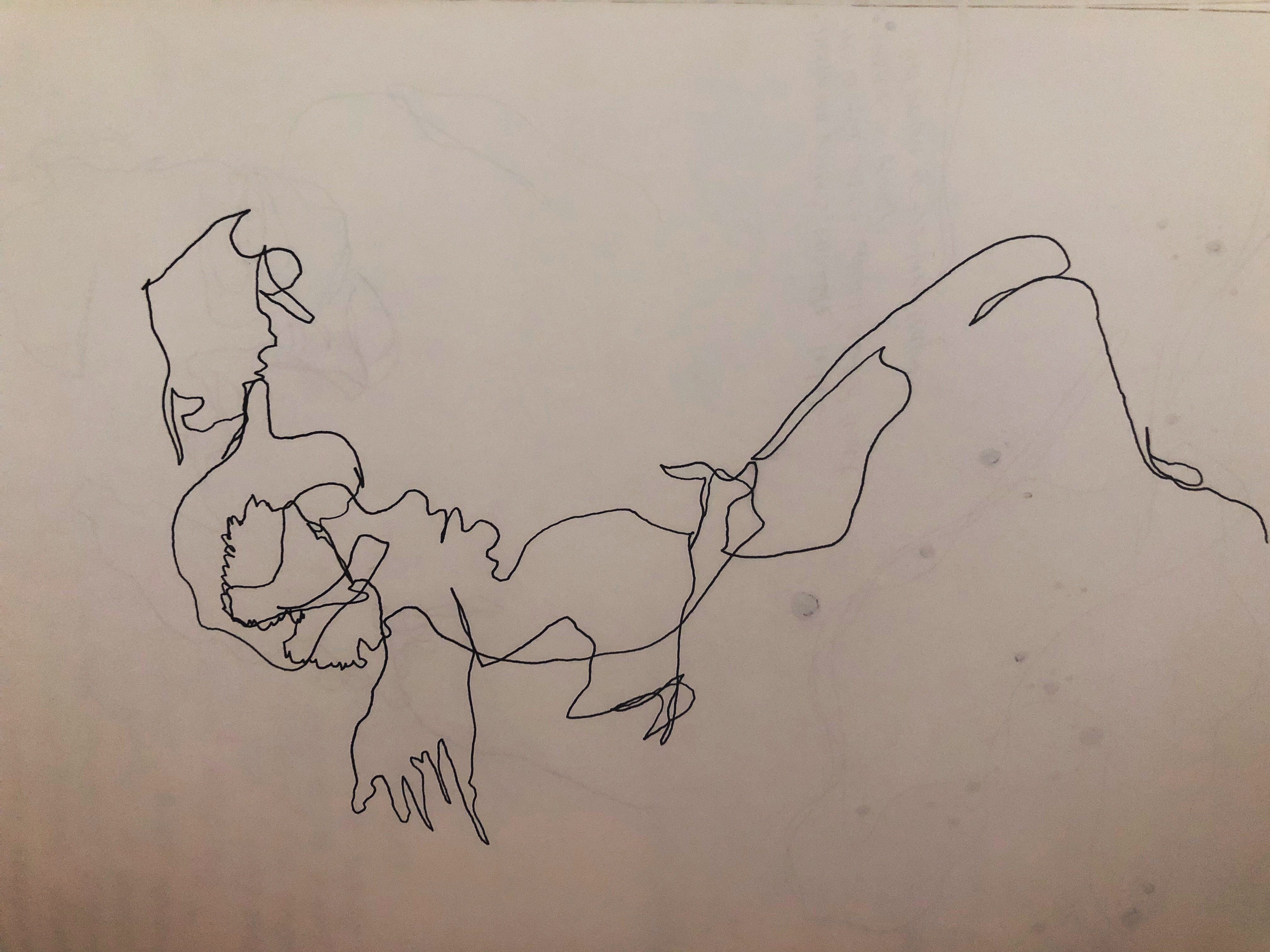
I met Jeanine at Salt Dance Fest in 2016 while I was immersed in this work with Abby. The connection I felt between their practices did not come from movement vocabulary. Abby’s work and Jeanine’s work made very different formal proposals. What connected them for me was the density of attention they demanded. Abby’s work taught me to notice how images reorganized force, coordination, breath, and endurance from inside my own body. Jeanine’s work extended my attention toward the relationship between thought, language, action, memory, and decision. Thinking remained active inside the dancing. Language did not explain movement, and movement did not illustrate language. They continually reorganized one another.
Over the years I returned to Jeanine’s workshops, writing, interviews, and conversations because they expanded questions that had already become central to my own practice. Approaching her in 2024 felt less like beginning something entirely new than committing to an inquiry that had been accumulating for years. Working Beings is one way of naming that inquiry for now. The title remains provisional because the work remains provisional.
This collaboration is the first time I have invited another choreographer to undertake sustained artistic research with me in Port Angeles. I don’t think I am trying to recreate the dance ecology I left in New York. I am attempting to understand what kinds of choreographic relationships become possible because the work is being built here, through this community, this hall, these supporters, this body, and this particular period of my life.
This is the first of three essays that will accompany Working Beings. I begin here because the invitation now sits several years behind me, while rehearsal still lies a few weeks ahead. The interval between those moments has become one of the most important parts of the work. It is where the project has changed, where my own life has changed alongside it, and where many of the choreographic questions I hope to carry into the studio have already begun to reorganize themselves.